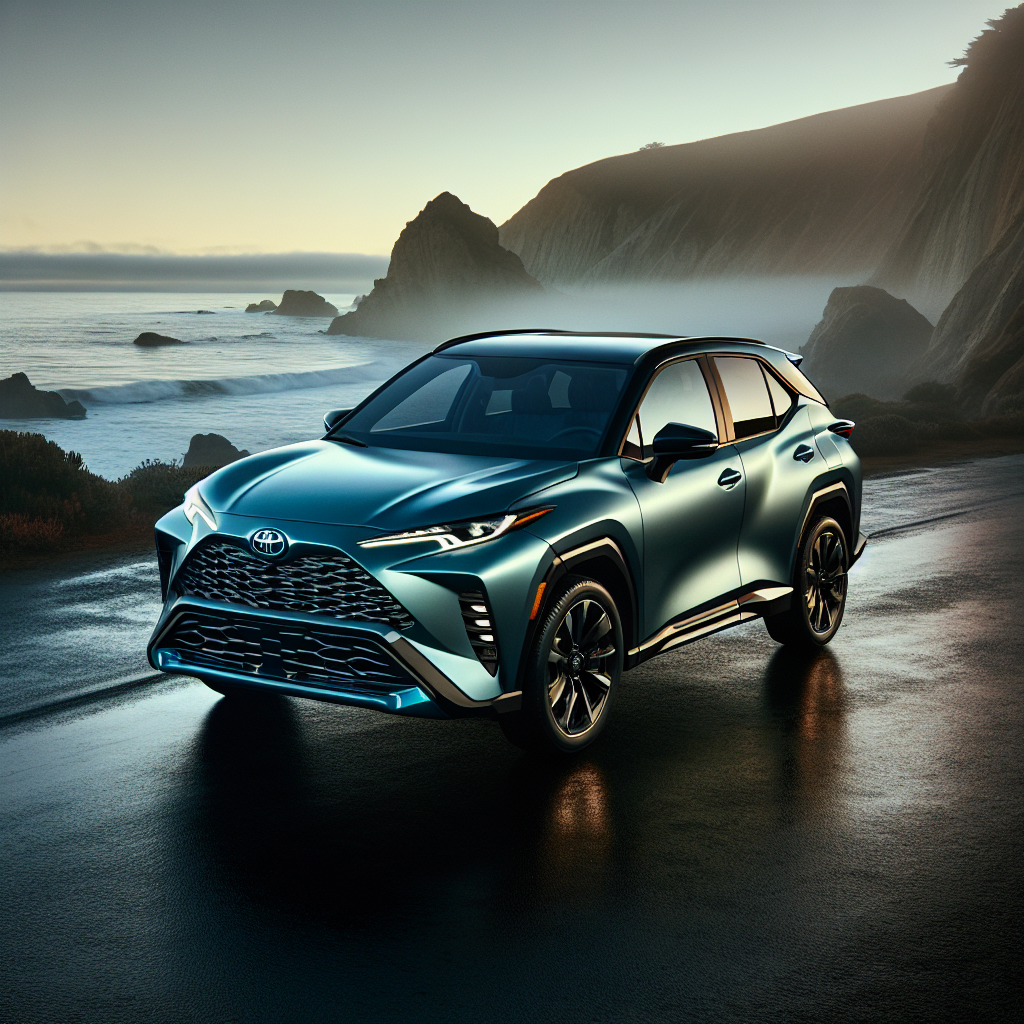
Tide & Tuna: 2026 Toyota Tuna XTR Review
 Mika Tide
·
Mika Tide
·
First impressions: a salty handshake
Walk up to the 2026 Toyota Tuna XTR and your first thought is: they really leaned into the motif. Subtle gill-like vents, matte blue-green paint Toyota calls "Ebb Metallic," and a sculpted rear that ends in a lip spoiler shaped suspiciously like a dorsal fin. It’s not ridiculous the way novelty specials can be; it looks confident, oddly athletic for a crossover, and it wears its theme like a wetsuit rather than a dress.
Powertrain & performance: diesel? no — hybrid muscle
Under the hood is Toyota’s new 2.5-liter Dynamic Cycle inline-4 paired to a 120 kW front electric drive and a 14.8 kWh lithium-ion pack. System output is a quoted 280 hp and 350 Nm of torque, routed through a simulated 6-speed CVT that Toyota tunes to feel like stepped ratios. Official 0-60 mph is 6.4 seconds — brisk for a compact crossover — and top speed is electronically limited to 135 mph.
Real-world numbers: on a damp backroad run I saw 6.6s to 60 with the drive mode in Sport, and mid-corner throttle response was sharper than I expected given the Tuna’s weight at 1,720 kg curb. The electric motor gives a strong first-gear shove — great for urban jaunts and tunnels — while the ICE settles into a smooth midrange hum above 3,500 rpm. There’s a faint mechanical growl that, when paired with the sporty exhaust map, gives the Tuna more presence than its displacement suggests.
Fuel economy & range
Toyota claims a combined 52 MPG (US) and about 38 miles of electric-only range. In my week of mixed city and spirited B-road testing I averaged 46 MPG with the battery recharging via regenerative braking and a lot of engine-assisted acceleration. If you commute 25–30 miles each way, the Tuna will happily cover most trips in EV mode and still deliver solid long-haul economy.
Chassis, handling and feel: wet pavement fun
Despite the crossover stance, the Tuna XTR was surprisingly nimble. The platform is a reworked TNGA with a slightly lowered center of gravity, stiffer anti-roll bars, and retuned adaptive dampers. The steering is direct with a touch of artificial weight that makes highway corrections confident. Roll is controlled with an almost sports-car discipline; Toyota tuned the suspension to be compliant over bad surfaces but communicative through mid-corner bumps. It’s a car that encourages you to chase apexes rather than admire the scenery.
There are trade-offs: the ride can feel choppy over railroad tracks and high-frequency ripples — the price of tighter damping. But for drivers who want a crossover that doesn’t insist on squatting in mopiness corners, the Tuna strikes a good balance between comfort and engagement.
Interior & technology: practical shells, premium scales
Step inside and the seafood theme recedes into tasteful detailing: blue-stitched seats, pebble-textured inlays, and ambient lighting that can be set to "Coast" (a soft aquamarine) or "Harbor" (deep navy). Materials are a noticeable step up from mainstream Toyotas — softer touch points, thicker door padding, and a seat base that manages support without sacrificing long-distance comfort.
- Infotainment: 12.3-inch center display, wireless Apple CarPlay and Android Auto, and a 10-speaker JBL tuned system.
- Driver assistance: Toyota Safety Shield 3.0 with adaptive cruise that reads curves, lane centering, blind-spot monitor with rear cross-traffic braking.
- Practicality: 540 liters of cargo space with seats up, 1,620 liters folded; 60/40 rear split; charging ports include two USB-C ports up front and one rear.
Toyota’s HMI is logical but not revolutionary. The HUD is crisp, and the digital dash can display hybrid flow, energy usage, and a rudimentary marine-themed animation that I admit made me smile more than it should.
Smell test: is there a fishy odor?
Yes, you asked for it. The Tuna XTR brings the joke into reality with an optional "Ocean Fresh" cabin fragrance system. The baseline car is neutral — no fish smell — but if you tick the silly box you get intermittent marine notes designed to evoke a seaside morning: citrus, salt air, and a faint kelp accord. It’s subtle and never overpowering; the scent system can be turned off. During spirited driving I noticed a faint oil-and-exhaust tang from venting at high rpm, but nothing that would make you regret opening the windows.
Safety & real-world usability
Structurally the Tuna scores highly in Euro NCAP-style crash simulators in Toyota’s internal testing, with reinforced A-pillars and improved side-impact beams. The suite of active safety tech is robust: intersection assist, auto emergency steering, and pedestrian detection that works well even in low light. Rear visibility is good thanks to a low load lip and a wide rear camera; a 360-degree surround system is available on higher trims.
Trim levels, pricing, and ownership
The Tuna XTR lineup has three trims: Base, Adventure, and XTR (the one in this test). Pricing starts at $34,900 for the Base, $38,900 for Adventure, and $43,800 for XTR. Toyota offers a 7-year/100,000-mile warranty on the hybrid components and a standard 3-year/36,000-mile bumper-to-bumper, which is competitive in this segment.
Should you pay extra for the Ocean Fresh package? Only if you enjoy your crossover smelling like a boardwalk cafe. The performance and chassis upgrades on XTR are what justify the premium.
The verdict: a crossover that swims upstream
The 2026 Toyota Tuna XTR is the rare novelty that earns its quirks through competence. It’s practical, efficient, and — importantly — genuinely fun to drive for a car in this segment. The hybrid powertrain delivers sensible economy without smothering personality, and the chassis tuning gives the Tuna an appetite for corners it didn’t have to cultivate.
There are compromises: ride harshness at broken tarmac and some synthetic steering weight, plus a price premium for the better trim. But if you want a crossover that avoids blending into the beige mall-mobility sea and you don’t mind a playful theme, the Tuna XTR is worth a test drive. It smells faintly of the ocean only if you ask it to, handles like it has something to prove, and, most importantly, drives like a Toyota that learned a few tricks from its sportier cousins.
Top speed: 135 mph (elec. limited). 0–60 mph: 6.4 sec (claimed). Real-world fuel economy: ~46 MPG mixed. Bottom line: an economical, competent, and slightly sardonic compact crossover that proves Toyota can make a fish joke and a great car in the same breath.